Field notes · Barcelona, Spain
Every showroom is designed to hide the supply chain. The parts we make are the ones the design rests on and the buyer never sees.
So we asked the customer to point at them.
Our team spent an afternoon at VIBIA in Barcelona with a camera. VIBIA is one of Spain’s best-known architectural lighting brands. Their team walked us past three fixtures and told us, part by part, what had come from our factory.
A walk through the VIBIA showroom, with the parts our team manufactured.
The first stop is the ceiling: curved brass and copper tubes carrying opal globes at different lengths. The customer runs a hand along the curve.
We make the tube work — bent sections, the joints where two arcs meet, and the cast fittings the cable passes through. Brass is unforgiving: bend it badly and every reflection shows the mark. So the sections are bent, welded, blended and hand-polished until the grain runs continuously across a joint.
Next, a single opal globe on a slim stem in a timber-lined alcove. The glass is not ours. The die-cast aluminium cap and the stem are.
The cap is a few centimetres across, and the fit is judged with a fingertip rather than a caliper. We CNC the seat after casting so the glass sits down without a visible gap, then finish the cap to match a stem made by a different process.
Outside, a floor lamp with a thin stem and a disc shade, and a vertical wall light on a dark grey bracket. The customer knocks on the bracket twice.
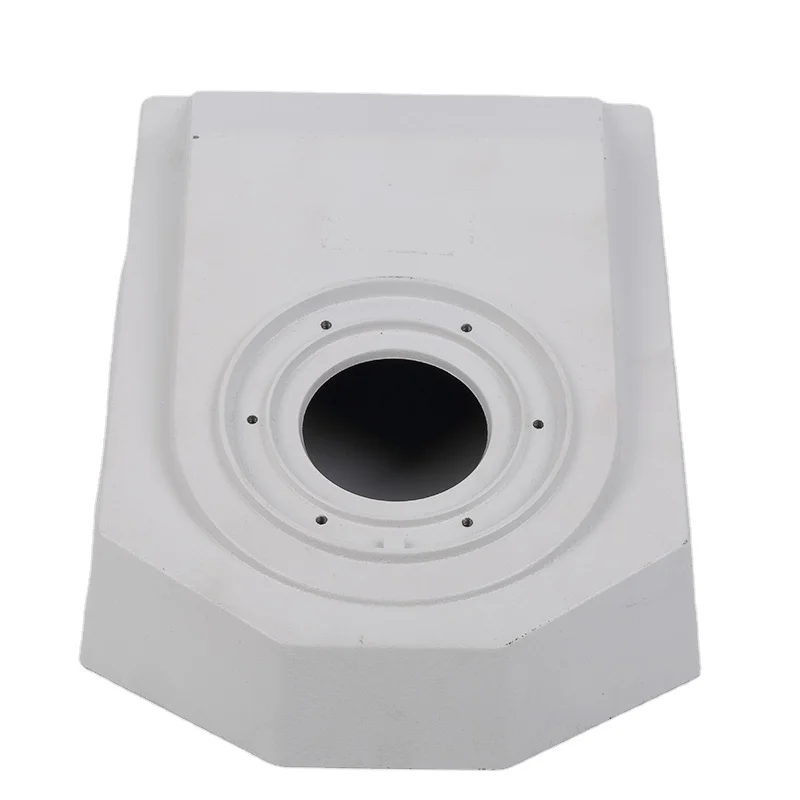
It is the least interesting part on the fixture and the one that decides whether the product survives a terrace: die-cast housing, machined gasket seat, anodised or powder-coated to the approved sample. Outdoor lighting fails at the seal, not at the light.
Not price. Whether the brass arcs still line up after welding, whether a cast cap and a machined stem read as one material under 3000K light, and whether the bracket still seals once four tolerances stack up inside it.
That is the argument for keeping the metal parts with one supplier: casting, CNC, tube bending, stamping and finishing planned against one tolerance stack and one approved sample.
Behind it sits IATF 16949 process discipline and more than 30 years of OEM manufacturing.
Have a part that looks simple and isn’t?
Send the drawing with the material, the finish and the annual volume. We will come back with a feasibility review and a price.
No minimum order to start. Drawings under NDA.
Yes. Send a sample and a 2D drawing. We confirm material and finish first, then quote against a defined specification.
Yes, before drawings are shared.
Custom lighting components · Brass tube bending · Die casting · CNC machining · Anodising · IATF 16949
 Hot News
2026-10-21
2026-10-19
2026-10-15
2026-10-14
2026-10-09
2026-10-07
Welcome to Runpeng, a Chinese custom metal company! We provide high-quality die casting, stamping, CNC machining, injection molding and mold making services.
6th Building, No 51, Nanhuan Ave, Gongming, Shenzhen, 518106, China.
Copyright © Shenzhen Runpeng Precision Hardware Co.,Ltd. All Rights Reserved Privacy Policy Blog
 EN