CNC turning · Turning cell
A turned part looks like the simplest thing in metalworking. Round, symmetric, one operation. In practice the difference between a part that assembles and a part that scrapes sits in a few seconds of cutting — and in everything that was decided before the spindle started turning.
A sleeve, a bushing, a shaft, a threaded pin: the drawing is short. The trouble is never the shape. It is a bore that has to run concentric to the OD, a thread that must engage a mating part made by someone else, a shoulder that has to seat flat, a surface that shows every tool mark under a light. Precision CNC turning parts are judged on those few callouts, not on the outline.
These three frames are from our turning cell — the same part, the same set-up, the same operator who runs the batch.
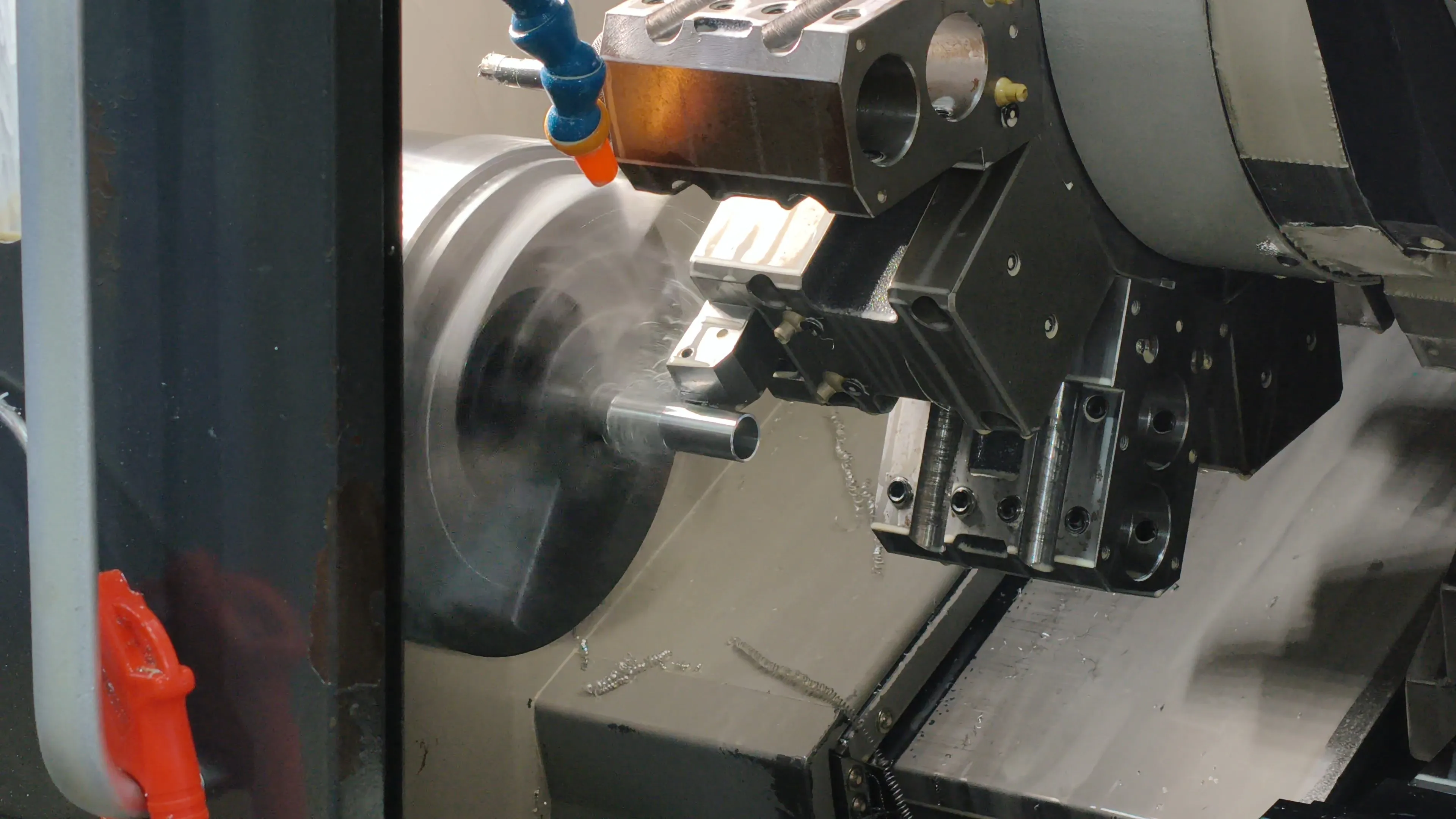
OD turning under flood coolant |
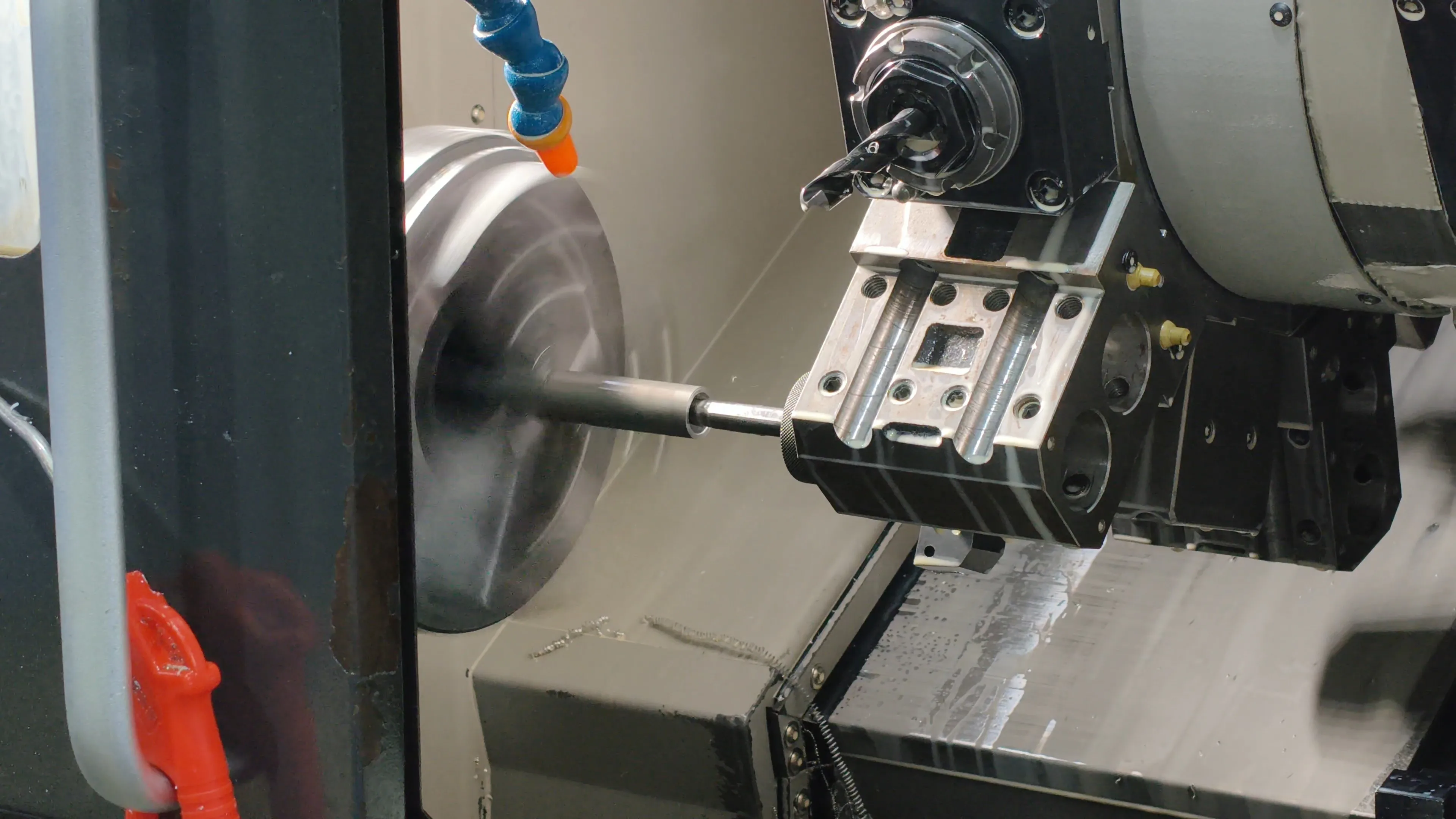
A slender shaft, one set-up |
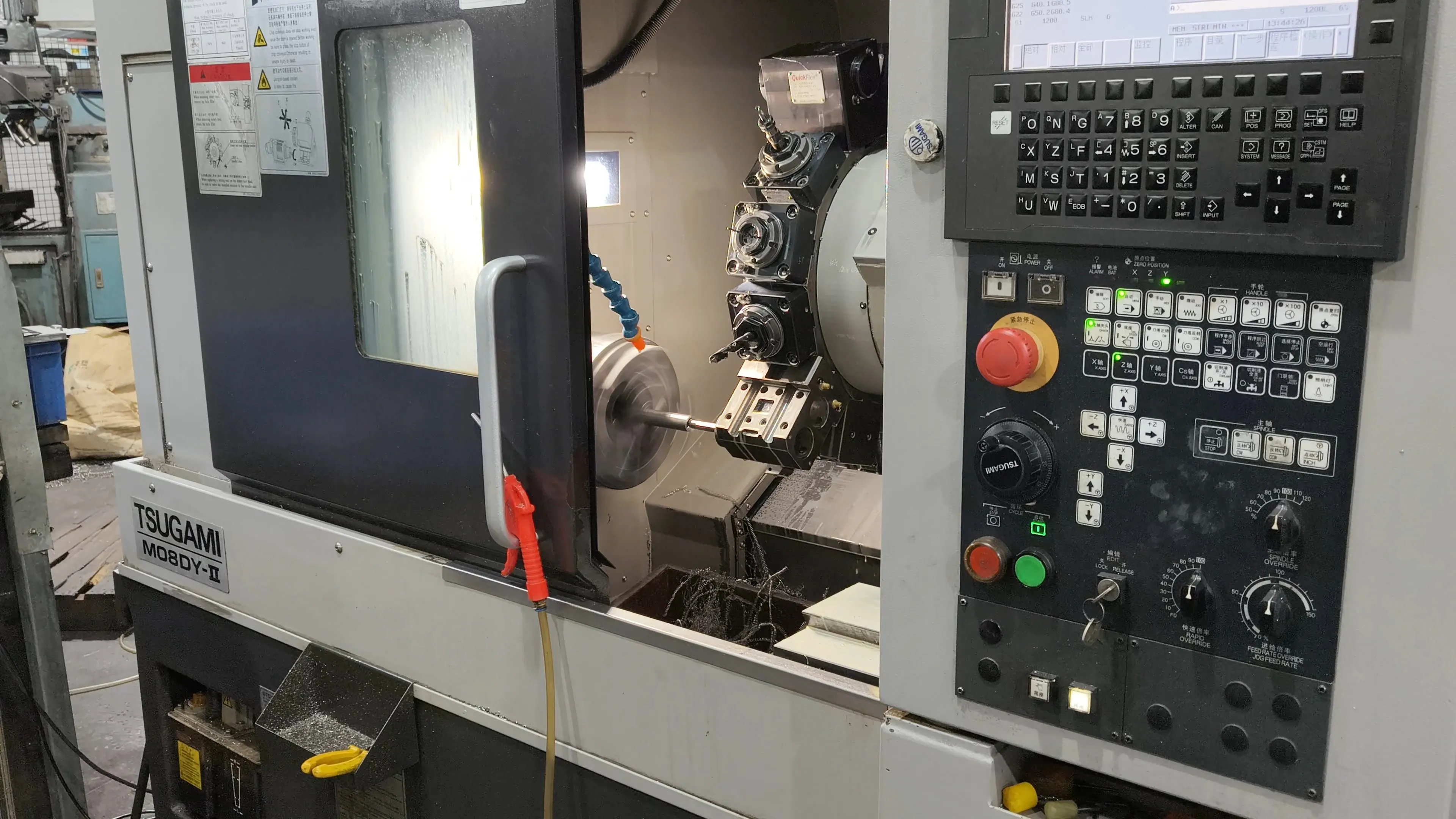
Tsugami M08DY-II gang-tool lathe |
Turning a stainless sleeve: rough and finish in the same programme, chips breaking clear instead of wrapping the finished diameter.
Cycle time on this sleeve is measured in seconds. Getting it to repeat for 5,000 pieces is the actual job.
Turning is the right process when the part is round: shafts, spacers, bushings, pins, threaded inserts, sleeves, valve bodies, sensor housings. It removes material fast, holds OD-to-ID concentricity well, and produces a thread or a sealing face in the same operation that produced the bore.
It is the wrong process when most of the geometry is off-axis — a plate with a hole pattern, a bracket, a pocketed housing. Those belong on a mill or a multi-axis machine.
The awkward middle is where most custom CNC turned parts live: a round body that also needs two flats, a cross-hole, or a milled slot. We machine both in the same shop, so the part does not become two suppliers, two tolerances and one argument about which feature is out. Ask for it as one part and one quote.
We are a fully OEM shop: we machine to your drawing and we do not redesign your part. That makes the input simple and the output predictable.
Prototypes typically run 15–30 days. Production lead time is confirmed in the quotation, because it depends on the process, the finishing step and the tooling — not on a number we can promise before we see the part.
If a callout on your drawing will be unstable in production — a thin wall, an interrupted cut, a thread too close to a shoulder — you hear it at quotation stage, with the reason, not after the first batch.
Send a drawing. Get a turning quote that holds.
Include the model or drawing, the material, the finish, the quantities and the two or three dimensions that actually govern fit. You get a feasibility review, tooling quoted separately where it applies, and cycle-time-based pricing instead of a guess.
Can you run a single piece?
Yes. MOQ is flexible and starts at one piece for prototypes and validation builds. The unit price reflects the set-up; the inspection does not change.
Do you do the finishing in-house?
Machining is in-house; anodising, passivation, black oxide and plating run through qualified finishing partners under our specification and inspection. Tell us the standard, not the colour.
How do you check the parts?
First article against your drawing or model, then sampling through the run according to the inspection plan agreed with you. Deviation reports can travel with the shipment if your QA asks for them.
What about our drawing?
Handled under NDA, used for quotation and production only.
Machining sits inside IATF 16949 process discipline, ISO 14001 and RoHS compliance, with more than 30 years of OEM manufacturing in Shenzhen — die casting, stamping, CNC machining and turning under one roof.
Tell us what the part has to do, and we will tell you how it should be turned.
Send the drawing or a rough sketch with the material, the quantities and the tolerance that matters. You get a feasibility answer and an indicative price — from an engineer, not a template.
Precision CNC turning parts · Custom CNC turned parts · Stainless steel turned components · OEM bushings and shafts · CNC machining Shenzhen · China
 Hot News
2026-11-24
2026-11-23
2026-11-18
2026-11-17
2026-11-10
2026-11-09
Welcome to Runpeng, a Chinese custom metal company! We provide high-quality die casting, stamping, CNC machining, injection molding and mold making services.
6th Building, No 51, Nanhuan Ave, Gongming, Shenzhen, 518106, China.
Copyright © Shenzhen Runpeng Precision Hardware Co.,Ltd. All Rights Reserved Privacy Policy Blog
 EN